

Guilty Until Proven Innocent
How ‘Believe All Victims’ Is Rewriting the Rulebook

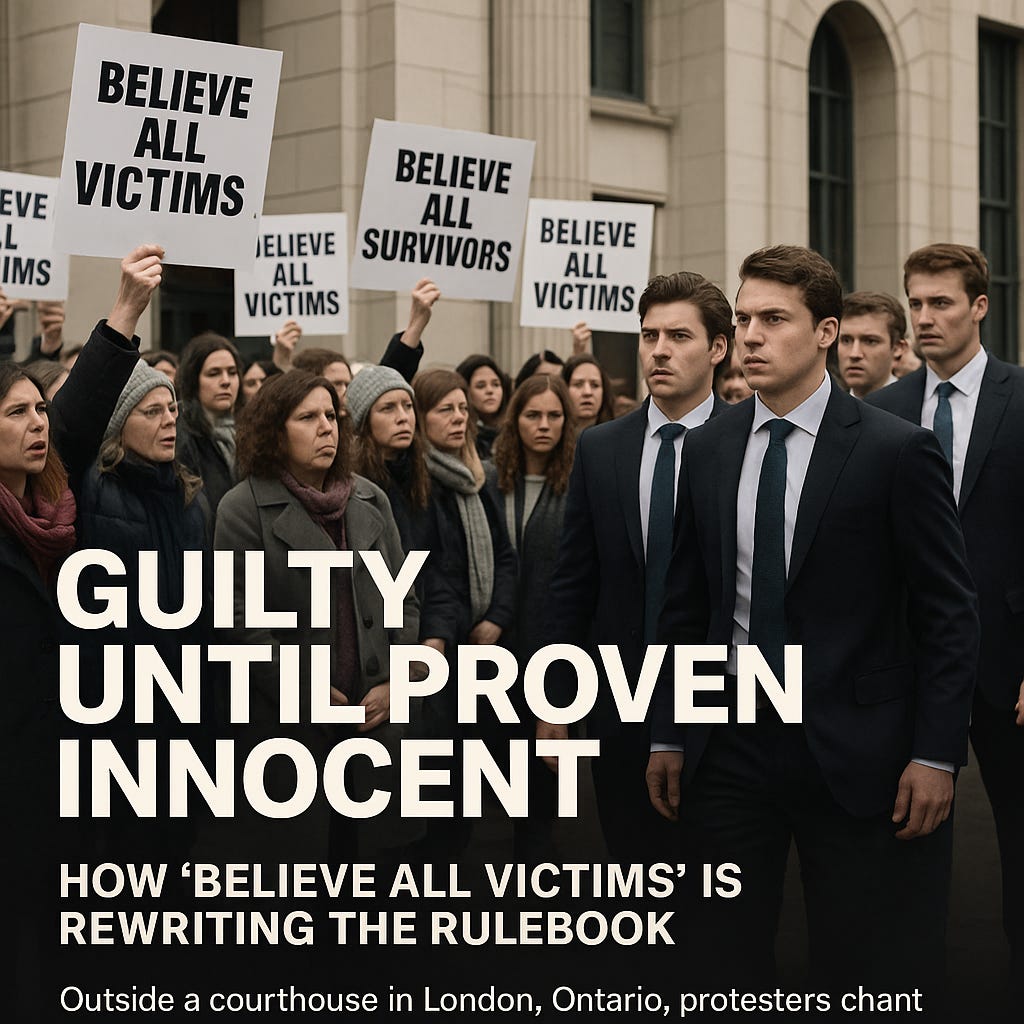
Society has been pushing a strong “Believe All Victims” narrative for several years now, spurred on by high-profile cases in the media and online. This trend is particularly evident in the ongoing trial of five former World Canada Junior Hockey players in London, Ontario. Outside the courthouse, groups of protesters — many of whom are women with signs declaring “Believe All Victims” or “Believe All Survivors” — are making a forceful statement.
But while sexual assault is a grave offense that should be investigated thoroughly and taken seriously, there is a critical problem with defaulting to a position that inherently presumes the guilt of the accused. The principle of “innocent until proven guilty” exists for good reason: it prevents a rush to judgment and protects against the all-too-real possibility of wrongful convictions.
Our society has lost the ability to appreciate ‘nuance.’ IN fact I think “nuance” is the new ‘n’ word in public discourse. It’s all black or white, with no capacity to acknowledge that both men and women can commit deplorable acts. Historically, the legal system did fail many victims of sexual assault because “he said, she said” without hard evidence often meant no justice. But if the pendulum swings too far the other way, we run headlong into another paradox: how do you prove someone is lying for financial or personal motives? This can be even harder to demonstrate. And let’s not kid ourselves… if we recognize that frauds exist in the motor vehicle accident (MVA) world (where people fake or exaggerate injuries), why wouldn’t that same opportunism exist in sexual assault claims, especially when a settlement can be even larger?
I know this all too well. I’ve represented actual victims of sexual assault, men and women fighting tooth and nail to get them the justice they deserve. But I’ve also fought for men who were wrongfully accused. Through these battles, I’ve developed a knack for sussing out the truth on both sides. Yet even that skill can’t counteract a judicial climate that’s steadily abandoning due process in favour of pandering to public outcry. It’s nauseating to watch lawyers who should know better pushing “Believe All Victims” without a shred of evidence, just to ensure a financial windfall and ride a wave of popular sentiment. Where is the critical thinking they were trained to exhibit?
In a just society, we must ensure fairness in the legal process. Promoting the notion of “Believe All Victims” can undermine that fairness in three critical ways: it tilts the scales against the presumption of innocence, it influences jurors through public pressure, and it creates an environment ripe for wrongful allegations that can destroy lives.
Presumption of Innocence Under Threat
Canada’s justice system enshrines the presumption of innocence as a bedrock principle. That means police, prosecutors, and the courts should base their decisions on evidence, not on some feel-good policy that appeases protestors or institutional directives. Yet here we are, with police services in many jurisdictions effectively told to lay charges on the thinnest claims, ditching their duty to fully investigate. Instead of examining whether a complaint is corroborated by actual proof, they pass the buck onto the courts, resulting in a system jammed with questionable cases.
Yes, “Believe All Victims” started as a rallying cry to ensure real survivors aren’t dismissed or silenced. But the reality is it’s morphed into a presupposition of guilt. If you label yourself a “victim” or “survivor,” the public narrative too often assumes the crime definitively occurred. Meanwhile, the accused is instantly smeared. It’s a lazy approach to justice, an approach that abandons critical inquiry in favour of hollow virtue-signalling.
I’m not saying we should ignore allegations. Far from it. We should investigate them rigorously. We should lay charges when the evidence meets the threshold. But charging people based on nothing more than an untested claim is a violation of our most fundamental legal safeguards. When the system trades in caution and concrete proof for rushed accusations and sensational headlines, we all lose.
The Effect on Jurors
In high-profile cases, jurors are under immense pressure. Walking past a mob of protesters chanting “Believe All Survivors,” a juror could easily feel that returning a “not guilty” verdict is akin to spitting on victims everywhere. That subconscious suggestion is powerful: to acquit is to be complicit in sexual violence, or so the public script goes.
But justice isn’t about pleasing the crowd. It’s about carefully weighing evidence. And yet, when protest signs and media soundbites proclaim an accused’s guilt from day one, the psychological deck can be stacked before the first witness testifies. That’s not how you get a fair trial; that’s how you get a show trial.
Wrongful Allegations and Real Victims
It’s uncomfortable to admit, but not every accusation is truthful. Yes, genuine survivors exist and often face tremendous hurdles seeking justice. But equally factual is that some people lie about assault, exaggerate the details, or spin a messy sexual encounter into a criminal offense for financial gain or personal revenge.
A wrongful allegation isn’t just an inconvenience; it can obliterate someone’s reputation, career, and future. Families get torn apart. Depression, isolation, and suicide can follow. Meanwhile, the “victim economy” flourishes… certain lawyers, activists, and organizations benefit financially or gain fame from championing every complaint, no matter how weak the evidence. If there’s a potential for a big civil payout, that’s often motivation enough to push for convictions.
Look at the Hockey Canada case. The complainant has already settled financially with Hockey Canada. A conviction for any of those five accused players is practically guaranteed to open the door for another larger settlement, especially given their assets and celebrity status. Scrutinizing these financial motivations isn’t victim-blaming; it’s honest, hard-nosed legal logic. When there’s money on the line, you have to question incentives.
The Shifting Definition of Consent
Consent is the linchpin of sexual assault cases. The legal system has rightfully evolved to address the complexities of consent, ensuring that “no means no,” and that consent must be ongoing. Where it gets murky is when we start talking about retroactive withdrawal of consent based on regrets or changed feelings after the fact.
In this Hockey Canada scenario, we’ve heard there’s a video showing the complainant consenting at the time. She apparently described acting like a “porn star” and possibly inviting additional participants. But the Crown Attorney’s approach suggests they’re more interested in how she felt the next morning than in what she demonstrably said or did in the moment.
If we start mixing regret with non-consent, we’re on shaky ground. Yes, we must prosecute genuine assaults and address situations where people are coerced, incapacitated, or otherwise unable to give meaningful consent. But let’s not stretch the definition so far that consenting adults can be retroactively labeled perpetrators because one party later wishes it hadn’t happened. That’s a recipe for perpetual confusion and blatant miscarriages of justice.
Logic Over Emotion
Sexual assault is a gut-wrenching topic. It should stir emotions; we’re human, after all. But there’s a difference between being passionate about justice and sacrificing every principle of due process to appease that passion. When we let raw emotion dictate policy, we encourage the kind of mob justice that used to see innocent people lynched in the town square. It’s no improvement just because the gallows are now Twitter feeds or protest signs.
An accusation, no matter how strongly stated, isn’t proof. We should absolutely take each claim seriously, investigate thoroughly, look for corroboration, examine physical evidence, and dig into the context. But if society equates “accuser” with “automatically telling the truth,” we’ve basically decided that fairness and evidence no longer matter as the gender of the accuser.
The Courage to Uphold Justice
True courage in this environment is calling out the madness. It’s standing up for the presumption of innocence even if you get labelled an apologist. Ironically, it’s the same courage required to stand with real victims who desperately need justice. Because here’s the bottom line: we can’t help genuine survivors by railroading the innocent. When the justice system loses its legitimacy, everybody loses, except maybe the opportunists who profit from the chaos.
We’ve become a society that thrives on certainty without evidence and punishes anyone who dares to ask inconvenient questions. This black-and-white worldview erodes any hope of nuanced, critical thinking… precisely what’s needed in complicated cases like sexual assault allegations.
A Call for Open Debate
So here’s my challenge to any lawyer, advocate, or concerned citizen who insists on the “Believe All Victims” approach: let’s debate. Let’s do it publicly, let’s do it face-to-face, and let’s do it without the mob demanding compliance. The principle of taking allegations seriously can and should coexist with the presumption of innocence until guilt is proven. If you believe otherwise, then by all means, show me the logic. Don’t hide behind rallying cries and hashtags.
Let’s talk about how best to give genuine survivors the support and justice they need, while also protecting the falsely accused from life-shattering punishments. Let’s bring logic, nuance, and impartiality back into our conversations about sexual assault. There’s no shame in admitting complexity; it’s actually a sign of intellectual honesty and respect for the real human beings caught in these legal battles.
If you disagree, I’m ready for your counterarguments. And I’m more than willing to jump into a live debate, where we can really dissect these tough issues. Sadly, it’s often the fiercest “believe all” advocates who prefer staying in safe spaces and echo chambers. It’s easier to chant slogans there than to confront someone who isn’t afraid to push back. But if you’ve got the courage and the facts, step forward. Let’s see if the justice system and public discourse can finally return to the realm of reason.
Written by the Rogue Lawyer: Fearless enough to challenge the loudest voices, committed enough to find real solutions.
It is hard to dialogue about this subject without people fearing that they will be attacked. I am certainly being attacked for daring to suggest we apply common sense