

Masks to Forest Bans
Are We Sleepwalking into Permanent Government Control?

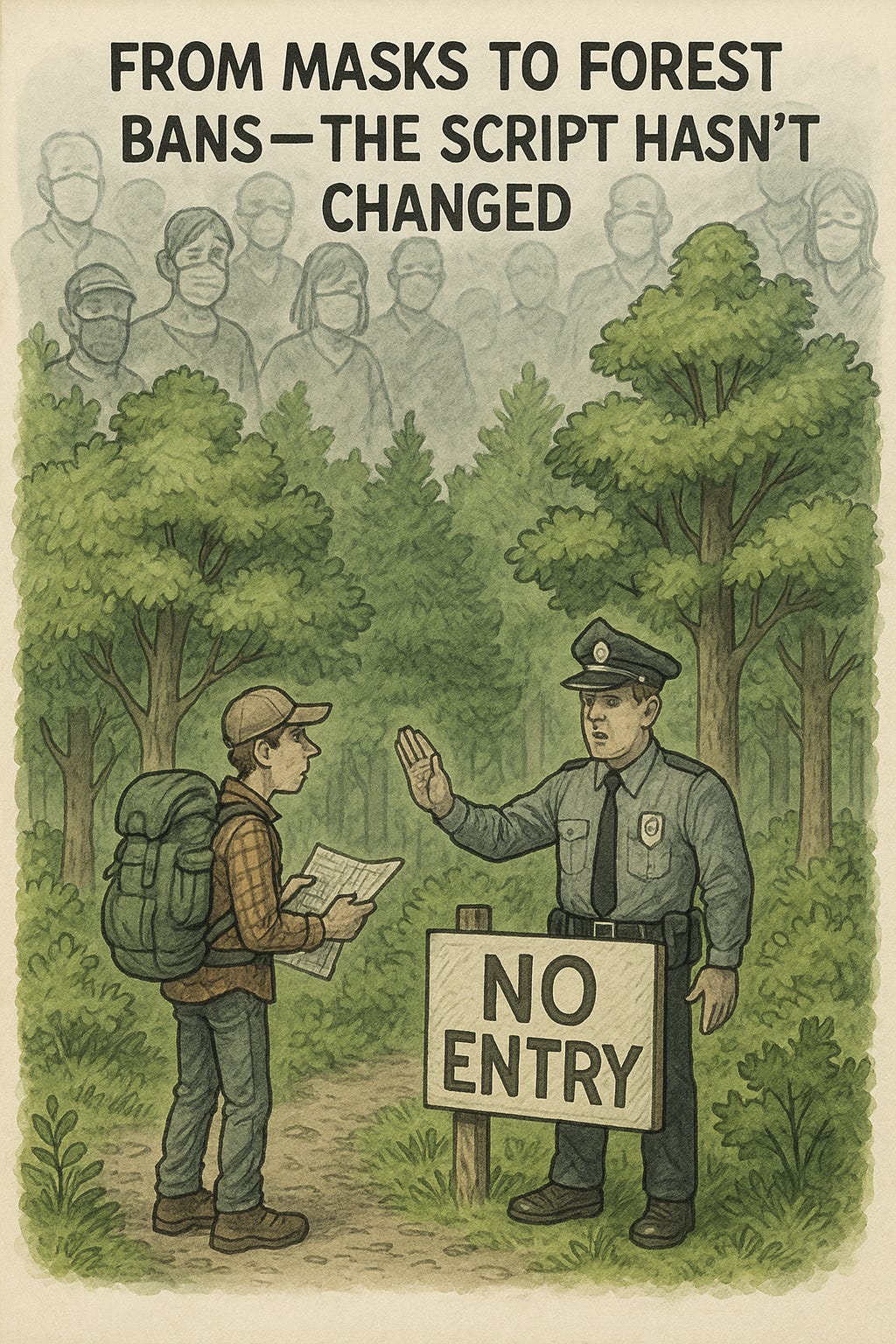
Nova Scotia recently banned people from walking in the forest to reduce wildfire risk.
On its face, it sounds reasonable, who wants to see another fire disaster? But the speed with which we accept sweeping restrictions on ordinary life should alarm anyone who remembers how quickly COVID-era “temporary” rules became permanent habits and how signalling overrode logic.
During COVID, governments learned a powerful lesson: if you frame restrictions as “for the greater good,” most people will comply without question. Some will even police their neighbours. We saw it with masks. Now, we see it again with forest bans.
This isn’t to say there’s no risk of fires, of course there is. But under the Canadian Charter of Rights and Freedoms, mobility rights (s. 6), freedom of association (s. 2(d)), and even liberty (s. 7) can only be restricted if the government can prove the measure is reasonable, proportionate, and minimally impairing. That’s the legal test.
Blanket bans with little evidence that walkers in forests actually cause fires? That’s questionable under s. 1 of the Charter, which demands demonstrable justification. If the goal is fire prevention, why not ban activities with actual ignition sources, campfires, ATVs, rather than all human presence?
The Psychology:
The Resisters: People who intuitively distrust government overreach, often dismissed as “anti-authority.”
The Enforcers: People who gain social value by signalling virtue through enforcement, even when the rule is flawed.
Both roles are predictable, and both were on full display during COVID.
Every “just for now” restriction normalizes a higher baseline of government control. If we accept that walking in a forest can be banned without clear evidence, what else can be restricted when “experts” declare an emergency?
The Logic Test:
Rational Goal? Yes, prevent wildfires.
Evidence of Effectiveness? Weak, human walking without ignition sources rarely causes fires.
Minimal Impairment? No, targeted measures would achieve the same goal without restricting all access.
Protest or Obey?
Obedience is comfortable, but blind obedience is dangerous. Protest doesn’t have to mean anarchy; it means demanding proportionate, evidence-based policy. In this case, that might mean challenging the ban legally or publicly, not ignoring fire risks but refusing to rubber-stamp symbolic restrictions.
The real fire isn’t in the forest; it’s in the creeping acceptance that your freedoms can be suspended on vague justifications. You can’t fight that blaze with compliance. Rather than invest in clearing brush, increasing forest fire resources, it is much easier for politicians to tell citizens to stay indoors.
Let’s hear your thoughts below.
It certainly feels like we are heading into permanent government control. It concerns me immensely how easily these officials got up and gave the news of the restrictions as if it was just another normal day at the office.
Very good argument.